

Brands prefer the fantasy of continuity. The story where everything builds cleanly and logically upward. Where success compounds and mistakes become footnotes. Where the logo evolves, but the core never really has to.
There are great quotes in the life of this world. Quotes that have moved people toward something better. Quotes that have made first-year philosophy students roll their eyes. Quotes that have made dads sound like strange medieval doctors with a mystical connection to universal medicine that only arrives with age and confidence.
We’ve all had this one tossed at us by someone clearly trying to help: “That which does not kill you makes you stronger.” That old chestnut from Friedrich Nietzsche. He saw life as a struggle. Every challenge survived, every hit absorbed, built fortitude and affirmed existence. He handed that idea down to the rest of us and said, good luck.
Same idea, different words, different person, or was he? Who knows. Hemingway put it this way in A Farewell to Arms: “The world breaks everyone, and afterward, many are strong at the broken places.” You could argue it’s the same thought. Or you could argue Hemingway was less interested in strength and more interested in damage.
Then there was my dad.
Whenever one of us kids got cut or dinged up playing outside, his medical advice was simple: “Rub some dirt in it.” If the pain crossed a certain threshold, he’d escalate to, “Walk it off.” No metaphysics. No philosophy. Still, the message aligned perfectly with both Nietzsche and Hemingway. You’re going to get hit. You can deal with it, or you can stay down. Either way, there are ribs for dinner.
None of these men was offering comfort. They were stating facts. The world is ugly and painful and unpredictable. Sometimes you make it through, and sometimes you don’t. If you do, you get a little tougher in the places that took the hit. Then life winds up again and throws the next thing. Repeat. Fade.
At least my dad pretended everything would be fine while telling me to grind dirt into an open wound.
The world breaks us. You feel it in the daily grind. You see it on the side of the road, some unlucky animal crushed at the edge of the highway, and you think, there’s really no opting out of this, is there? No one gets a pass. No one is exempt from life’s cruelty or its strange sense of humor.
So if what doesn’t kill me makes me stronger, then I can just keep taking more and more until I’m dead. Or I become indestructible. Neither option feels especially reassuring.
Brands don’t like this idea.
Brands prefer the fantasy of continuity. The story where everything builds cleanly and logically upward. Where success compounds and mistakes become footnotes. Where the logo evolves, but the core never really has to.
But the world breaks brands, too.
Markets shift. Categories collapse. Audiences move on. What once felt obvious starts to feel thin. Not because the brand failed, but because time did what it always does. It applied pressure. It tested assumptions.
Most brands panic early. They rush to protect the surface. New messaging. New positioning. A brighter tone. The work becomes about looking intact instead of becoming something sturdier.
The brands people actually trust tend to do something quieter.
They change at the break. Not cosmetically. Structurally. You can feel it in the restraint. In the clarity. In the way they stop trying to be everything they used to be.

What Actually Breaks When a Brand Breaks
When a brand breaks, it’s almost never the thing they point to. They’ll say it was the campaign, or the website, or the messaging. Sometimes it was timing. Sometimes the market. Sometimes, if you listen closely, the audience. These explanations sound reasonable because they’re visible and because they give the brand something concrete to fix.
But what actually breaks is usually smaller and harder to admit. It’s an assumption the brand didn’t realize it was leaning on. A belief about who the customer was, or why they cared, or what would always be true as long as the brand stayed consistent enough. Those beliefs don’t shatter loudly. They thin out. They stop holding weight. And when they go, everything built on top of them starts to wobble, even if it still looks fine from the outside.
This is where most brands misread the moment. They assume the problem is clarity or confidence, so they respond by reinforcing what’s already there. More explanation. More optimism. More energy. As if the issue is that people don’t understand them well enough yet. Usually, people understand just fine. They’ve just moved on.
So the brand stays busy. It reassures. It keeps talking. It confuses motion with progress and activity with adaptation. From the inside, this feels responsible. From the outside, it feels like noise.
The brands that survive this moment don’t rush to fix what broke. They pause long enough to ask why it mattered in the first place. They let go of parts of themselves they once defended. They narrow their focus. They choose sides. They disappoint some people on purpose. It feels like loss internally, but it reads as honesty externally.
The Performance of Confidence
When something starts to go wrong, brands don’t usually reach for honesty. They reach for confidence. Confidence feels safer. It reads as leadership. It reassures the people inside the building and signals steadiness to the people outside it. In moments of uncertainty, confidence looks like the responsible move.
The problem is that confidence is easy to perform without changing anything underneath. It shows up as louder language, broader claims, and brighter tone. Everything gets framed as momentum. The future gets named early and often. The brand starts speaking in declarations instead of observations, as if saying something firmly enough can keep it true.
You see this most clearly in the way brands talk about change. Nothing is ever lost. Nothing is ever abandoned. Every shift is positioned as growth, expansion, evolution. Even when something clearly stopped working, the story insists it was part of a larger plan all along. The brand doesn’t acknowledge the break. It narrates around it.
This kind of confidence has a shelf life. Audiences can feel when certainty is covering for confusion. They may not articulate it, but they sense the mismatch between what’s being said and what’s actually happening. The result isn’t outrage or backlash. It’s quiet disengagement. Attention drifts. Trust thins. The brand keeps talking, and fewer people bother listening.
From the inside, this behavior often feels like discipline. Stay on message. Don’t show doubt. Protect the brand. But what’s really being protected is the version of the brand that existed before the break. The work becomes about maintaining continuity rather than responding to reality.
Real adaptation looks different. It’s slower. It’s less polished. It involves admitting that something once believed to be essential no longer is. That kind of shift can’t be performed. It has to be lived through. And because of that, it rarely looks impressive in the moment. It just looks quieter.

What Restraint Looks Like From the Outside
Restraint is hard to spot if you’re looking for confidence. It doesn’t announce itself. It doesn’t come with a tone shift or a big reveal. From the outside, it often looks like a brand doing less, not more. Fewer claims. Narrower language. A noticeable absence of the things it used to lean on.
This is where brands start to feel different in a way that’s hard to articulate. The work stops trying to cover every angle. The brand no longer feels obligated to explain itself to everyone. Certain phrases disappear. Certain ambitions quietly get retired. Not because they were wrong, but because they’re no longer essential.
What’s interesting is that restraint often reads as clarity, even though it usually begins as uncertainty. The brand has learned where it can no longer bluff. It has felt the cost of saying yes to everything, of carrying too many meanings at once. So it starts choosing. And choosing, by definition, means leaving things out.
From the inside, this phase can feel uncomfortable. It feels like contraction. Like loss. There’s usually a moment where someone worries the brand is becoming smaller, less relevant, less exciting. But what’s actually happening is focus. The brand is learning what it can support without strain.
Audiences respond to this not because they admire discipline, but because they recognize honesty when they see it. The work feels considered. The voice sounds like it knows what it’s for and what it’s not. There’s less urgency to convince, less need to impress. The brand stops trying to outrun its own history.
This is often when trust begins to rebuild, quietly. Not because the brand promises something new, but because it finally sounds like it understands what it’s been through. The break isn’t referenced. It doesn’t need to be. You can feel it in what’s no longer being said.
Strong at the Broken Places
This is the part that’s easy to misunderstand. Strength doesn’t show up as recovery. It doesn’t look like getting back to where you were. It rarely looks like momentum at all. More often, it looks like accommodation. Like a body learning how to move differently after it’s been hurt.
That’s what Hemingway was getting at, whether he meant to or not. The world breaks everyone. Not selectively. Not symbolically. Everyone. And afterward, some people learn how to live with the damage in a way that changes how they carry themselves. They don’t become harder everywhere. They become sturdier in specific places because they have to.
Brands work the same way. The ones that last aren’t the ones that avoided damage. They’re the ones that stopped pretending they hadn’t been changed by it. They don’t return to form. They adjust their form. They reorganize around what they now know to be true.
This is why the strongest brands often feel narrower than they used to. They’ve learned the cost of being diffuse. They’ve felt what happens when too many promises pull in too many directions. After the break, they stop chasing optional meaning. They hold onto the parts that can actually bear weight.
From the outside, this can look like humility, but it’s really precision. The brand knows where it’s vulnerable now. It knows what it can’t afford to fake. That awareness becomes part of the structure. Not something it talks about, but something it operates from.
There’s a difference between endurance and adaptation. Endurance is staying upright through pain. Adaptation is changing shape so the pain doesn’t keep landing in the same place. One is stubborn. The other is intelligent.
The world doesn’t reward brands for surviving unchanged. It rewards the ones that learn, quietly, how to live with what broke them and let that knowledge inform the work. Not as a story. Not as a badge. Just as a fact of how they now exist.
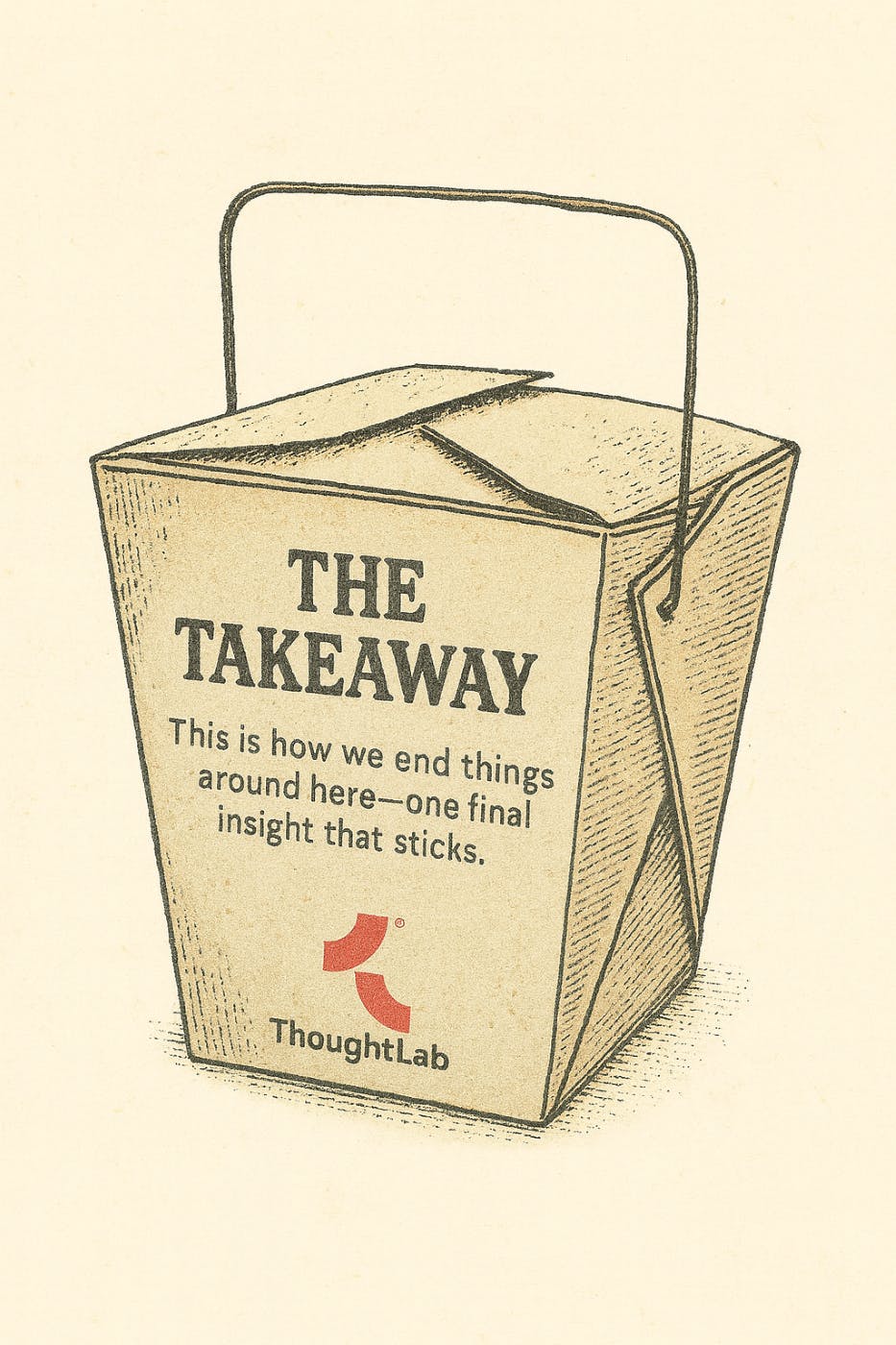
The Takeaway
We tend to reward brands for looking strong. For sounding certain. For staying smooth in a world that isn’t. But that kind of strength is usually cosmetic. It assumes continuity is the goal and that any real disruption should be hidden, reframed, or hurried past.
The brands that last don’t do that. They let themselves be changed. Not loudly. Not heroically. Just honestly. They accept that something true about them broke, and they stop organizing their work around who they used to be.
The world is going to apply pressure whether a brand is ready or not. It will test assumptions. It will wear down what was never meant to carry that much weight in the first place.
This is the kind of moment we pay attention to at ThoughtLab. Not the polish after the fact, but the quieter shift underneath. The place where a brand decides whether it’s going to perform strength, or become different enough to actually hold it.