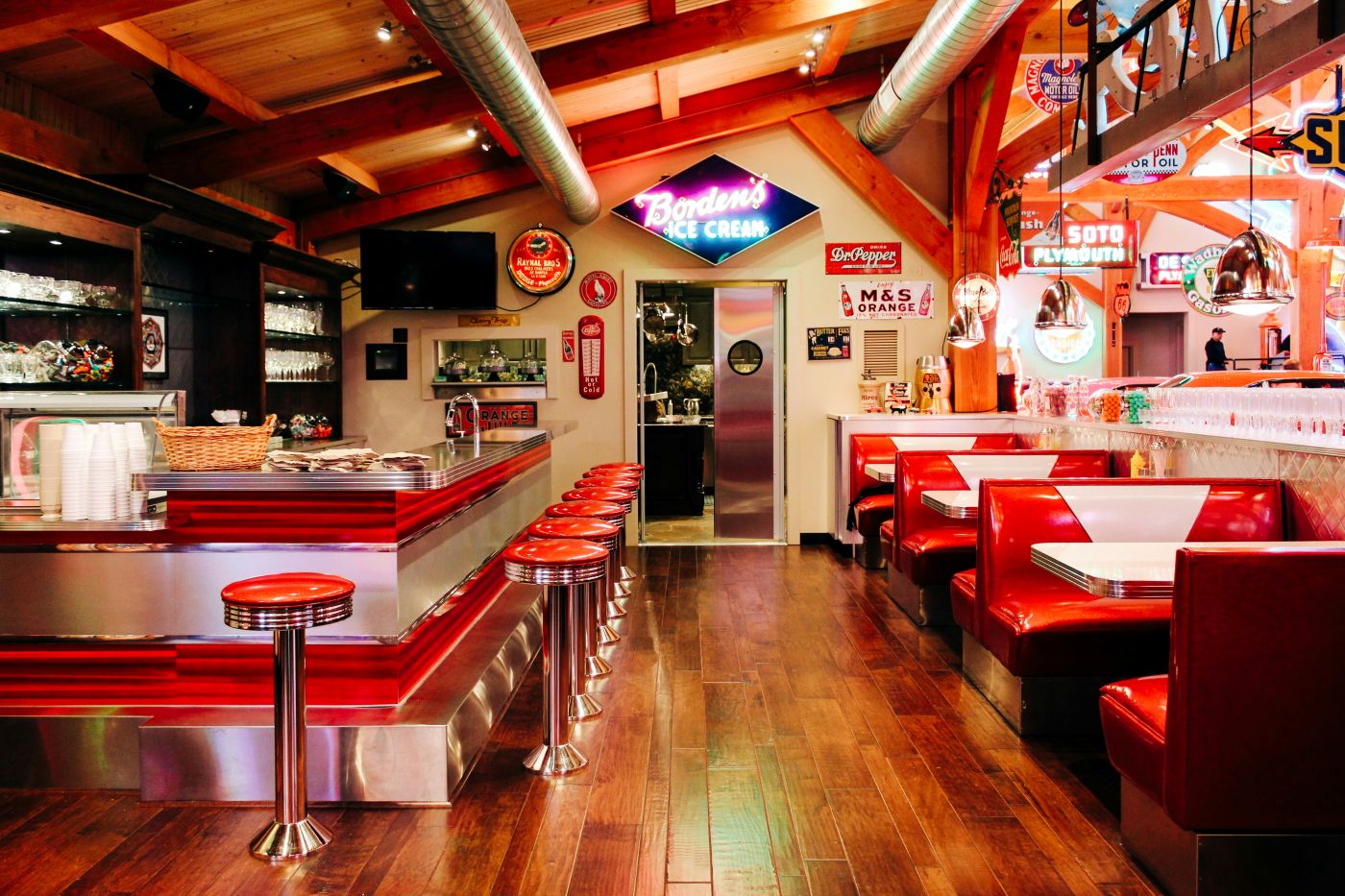
The second discovery, like my drive to make movies, has stayed with me ever since. The second thing I discovered was that I love diners. Love them; however, I love a very specific type of diner. I love the diners that remind me of that film set. The weathered feeling, the age on the walls and counters. The close feeling, the image of the stools along the counter full of guys smoking and drinking coffee.
When I was a kid, a movie crew came to my little hometown and set up a diner. A true-to-form 1950s-style diner. The diner was a 1920s Worcester Lunch Car (No. 594) that had previously operated in Cambridge. The film was The Brink’s Job, directed by William Friedkin and starring Peter Falk. This was back in 1978. They shot one scene there, and that was it. But the set stayed up for three weeks in case they had to reshoot. After filming wrapped, I rode my bike along Birch Meadow Drive, pulled into the vacant lot where the diner was set up, and looked around.
Two things happened that day as I spent more than three hours carefully slipping into the diner and looking about. One, I fell in love with the idea of making movies. See, there was so much detail: coffee cups and plates with toast and egg remnants. Stools and newspapers from the 50s lay next to ashtrays filled with filterless cigarette butts. The posters on the walls, the coffee maker, the grill in the back. It was all there. And I discovered that I could step from my life, a kid on his bike, into another dimension, another time, and get completely engrossed in it. I feel the same way to this day when I step on a set. I didn’t know the full extent of it that day, but I knew I wanted to be part of this business that could set up history in the present day and create a world that you could step in and out of. That was the first discovery.
The second discovery, like my drive to make movies, has stayed with me ever since. The second thing I discovered was that I love diners. Love them; however, I love a very specific type of diner. I love the diners that remind me of that film set. The weathered feeling, the age on the walls and counters. The close feeling, the image of the stools along the counter full of guys smoking and drinking coffee. The red leather booth benches, the menus with no lamination. There was history here, but it didn’t announce itself; it didn’t say, “Oh, look at this historical hall — it’s like a museum.”
It was very much like a museum in that diner car. I walked through it gingerly, not wanting to disrupt anything. I knew nothing about making movies at that time, but something in me knew that if I disturbed even a napkin, I would be making someone’s job much harder. I liked the feeling, and for me it was different than being in a museum. Museums say stay your distance, don’t touch, don’t look too close. This diner, this movie set, said: look, touch (though I didn’t fall for that particular siren’s call), be present, be involved. Although it felt like a museum, it felt more like a museum in motion, a museum of potential: just wait and see what we do here — that was the feeling that held me.
From that day, that three-hour exploration of a movie set that appeared in my small hometown, my life quest started. One: to make a movie. Not to be a movie star, just to be part of creating a movie. Be a part of taking people on trips into history and life. Two: to find diners like this one and frequent them.
Diners
Anyone can open a restaurant and slap the word diner on the side and go about their merry pancake-making ways. That’s fine, I’ve eaten in plenty of those, but they aren’t the diners I’m seeking out. Those are not the diners that make up my quest. I’ll try any diner to see if it incites the feeling I got creeping about that movie set back in 1978. Rarely do the places that call themselves diners but are set up like a regular restaurant cause me that kind of memory burst.
You see, the word “diner” itself actually comes from “dining car” on a train. Historically, these roadside structures were also called “lunch cars” or “night lunch wagons” because factories built them like railcars and shipped them on flatbeds. When an actual retired railroad car is repurposed into a restaurant, it is specifically called a railcar diner or Pullman diner, and those are the ones I love. They are the holy grail, and I have found them on roads you wouldn’t believe anyone traveled, in woods that suddenly open to a parking lot, and there is the diner. And when you go into one of these backwoods places, it’s always full or near full.
There are a couple of magical things that happen in a good diner. When you walk in, inevitably a waitress in a uniform, complete with a hat, will say, “Just sit anywhere, hon.” That word “hon” is what signals to me that I have hit on one of those places. At one place in Kentucky, where I went when I was with Kentucky Shakespeare, a waitress said to me, “Just plant that cute little butt anywhere, dear, I’ll bring you coffee.” I had a cute little butt! I haven’t heard that again in my life. Magic.
A couple of things let me know I’m in my kind of diner. The coffee is always good, and it’s strong. There are no little containers of half and half; there’s cream in a small pitcher, either steel or ceramic. There’s always a daily special that’s written on a board when you walk in, and if you’re polite and the waitress likes you, she’ll give you a tip. “Just between you and me, Earl (the short-order cook) has a batch of fresh boysenberry pancake batter we’re saving just for our special guests,” she might say — or she’ll mention some secret menu item they only tell their favorite customers about. Frequent these places long enough, and you’ll get to understand that everyone gets the tip, but it’s not written anywhere, so you feel like you got the real inside scoop.
One of the biggest tells that a diner is the kind I like is its physical state. If it’s polished clean and shiny, if it gets a paint job every month, if there are air dryers in the bathroom, or if there’s a sign that says, “Forgive our dust, we’re remodeling to make your experience better,” those are warning signs. You see, a good diner, with good food, nothing fancy, will always be a little bit dirty. A little sticky on the counters and tables. A few cracks in the wall plaster. A few of the chairs have been repaired with duct tape. The building shows signs of life and history; it’ll do you right. If it’s too clean, too new, too renovated, the life has gone out of it, but it will be fine; the food will be good, but the experience won’t be the one I’m looking for. A little dirt, a little grease, and that’s the place to beat. That’s my kind of diner.
Authenticity
“A real, authentic American experience” is what the sign for Joe’s American Bar & Grille in Venice says. Italians seemed to love the place. I went on a Tuesday evening, and the place was packed. A hostess approached me, said, “Howdy,” in a terrible American accent, and thus began my “authentic” American experience.
It’s fun to see what other countries define as an authentic American experience. Before I go any further, I have to confess that this experience happened years ago when being American in Europe was not a cause for hatred or pity. Americans were okay! So, it was great to see that an American experience featured happy faces, positive vibes, lots of sports references, and food that viewed the boundaries of a plate as mere suggestions. Those were the good old days, and I miss them dearly.
The experience was wonderful. My friends and I were Americans in what felt like an American museum. People took pictures with us, gave us lots of thumbs-up gestures, and the waiter kept telling us, “Just like in America, right?” But it wasn’t. Don’t get me wrong: the people were great, the atmosphere was fun and full of energy, and the food: buonissimo! Maybe it wasn’t authentically American, but the Italians sure know their way around a kitchen, so the food was incredible.
It was billed as a diner, but it wasn’t. It was too big, with too much open space; it had a bar, which traditional diners don’t have. But, above all, it was spotless, super clean and neat. No cracks in the plaster, no torn wallpaper, and no missing floor tiles. They did their best with American accents; I felt bad telling them that people from Boston, my hometown, don’t say howdy. Despite the accents and the assurance that everything was “just like in America, right?” it wasn’t. No one called me “hon”; there were no secret specials, and I had to ask for a refill, unlike the magical appearance of coffee in your cup at a good diner. It was fun and delicious, but it wasn’t an American diner. It was too polished, too put together; maybe it was too authentic, if that can be a thing.
I hadn’t joined ThoughtLab yet, hadn’t started my copywriter life yet, so I had no idea how overused and poorly defined “authentic” was.
Dirt in the Corners
I clearly recall my three hours of exploring the movie set diner in my little hometown. I loved the detail, like the dirt in the corners on the floor around the door jamb and the bottom of the counter. It made the set feel like it was part of the earth, part of the land of my town. I knew that much dirt couldn’t have formed on its own; the set had been there for a matter of days, but the dirt spoke of years.
The dust, the chipped paint, the cracked plaster, the chipped dishes and cups in the sink and on the tables — no one had to say, “This is an authentic diner experience”; you could see it all around you.
I have since joined ThoughtLab and learned that “authentic” is a gimmick; it’s marketing speak, and if you ask anyone in the business for a definition, you’ll never get the same one twice. “Authentic” has become one of those words we use when we want people to believe something about us without doing the considerably harder work of giving them a reason to believe it. Brands tell us they’re authentic. Restaurants promise authentic experiences. Companies talk about their authentic voice, authentic values, authentic relationships, authentic storytelling. Everybody is authentic now, which is probably the surest sign that nobody knows what the hell authentic means anymore.
The funny thing is, that diner I walked through in 1978 wasn’t authentic at all. It was a movie set. The dirty coffee cups weren’t left behind by customers rushing off to work. The cigarette butts hadn’t been smoked by guys sitting at the counter arguing about the Red Sox. The dirt around the door jamb hadn’t accumulated over twenty years of boots coming through the door. Somebody put it there. Somebody chipped the paint. Somebody decided exactly how dirty the floor should be. Somebody arranged those newspapers, dirtied those plates, filled those ashtrays and created the illusion of years in a place that had existed for a matter of days.
And I believed every bit of it.
That’s the part of authenticity we don’t talk about enough. Authenticity isn’t necessarily about whether something is literally real. Sometimes it’s about whether something is specific enough, consistent enough, and carefully considered enough that we accept it as real. The people who built that diner understood the world they were creating so completely that they knew the dirt mattered. Not because anyone watching The Brink’s Job was going to stop the movie, point at the bottom of the counter and say, “Now that is some historically accurate grime.” The dirt mattered because without it, something would have felt wrong.
That’s what Joe’s American Bar & Grille in Venice was missing. They had all the obvious stuff. They had the American food, the sports references, the accents, the portions, and enough Americana scattered around the place to make Uncle Sam feel underdressed. They had worked very hard to create an authentic American experience. But they had concentrated on the things people associate with America rather than the little things that make an American place feel American. They had the costume. They were missing the dirt in the corners.
Brands do this all the time. We identify the characteristics we think people expect from us, polish them up, put them on the website, and then wonder why the result feels manufactured. We add the right words. We adopt the right tone. We take pictures of employees laughing around conference tables. We tell people we’re passionate, transparent, human and, of course, authentic. Then we sand away every oddity, contradiction and imperfection that might actually prove there are human beings somewhere behind all that branding. Maybe authenticity lives in exactly those things.
Maybe it’s the slightly strange sentence nobody else in your industry would write. Maybe it’s admitting that you don’t have an answer instead of manufacturing one because the marketing calendar says something has to go out Tuesday. Maybe it’s keeping something customers love even though the consultants tell you it looks dated. Maybe it’s having enough confidence in who you are that you don’t have to constantly explain who you are.
Because the dirt in the corners isn’t really dirt. It’s evidence. Evidence that something has been used, lived in, bumped into, repaired, loved, and allowed to become itself over time. You can manufacture the appearance of that, as a very talented movie crew proved to a kid wandering around a diner set in 1978. What you can’t manufacture nearly as easily is the feeling that comes from all those details belonging together. And when they do, nobody needs the sign telling them it’s authentic.
Stop Saying Authentic
Maybe we should stop saying “authentic.” Not forever, perhaps, but at least until we figure out what we mean by it. Because the moment a brand has to tell me it’s authentic, I start wondering why it felt necessary to mention it in the first place. It’s a little like someone introducing themselves by saying, “I’m very trustworthy.” Maybe you are, but now I’m keeping an eye on my wallet.
The problem isn’t that brands shouldn’t try to be authentic. Quite the opposite. The problem is that authenticity works much better as evidence than as a claim. You don’t tell people you’re honest; you behave honestly. You don’t tell people you care about your customers; you answer the phone when something goes wrong. You don’t tell people you have a sense of humor; you make them laugh. And you certainly don’t become human by putting the word “human” somewhere in your brand guidelines. You make choices, repeatedly and consistently, that reveal something recognizable and specific about who you are.
That’s where the dirt in the corners comes back. A brand’s dirt isn’t incompetence, bad service, or some charming excuse for doing lousy work. Nobody wants a diner where the cook has to scrape yesterday’s eggs off the grill before making today’s. The dirt I’m talking about is the stuff that accumulates when you allow a business to have a personality. The quirks, habits, language, traditions and little imperfections that belong specifically to you. Things that might make a branding committee nervous because they aren’t polished enough, universal enough, or easily explained in a PowerPoint presentation.
Branding puts tremendous pressure on us to clean all of that up. We benchmark competitors, study best practices, test language, and smooth out anything that might confuse somebody. All of that can be useful, and sometimes absolutely necessary, but if you aren’t careful, you can keep polishing until there’s nothing left to recognize. The website looks beautiful. The copy is professional. The photography is gorgeous. Everything is exactly where it should be, and somehow the whole thing feels like Joe’s American Bar & Grille in Venice. Howdy, welcome to our “authentic” brand experience.
The brands that feel authentic rarely seem to be working very hard at convincing you. They know what they are, and that understanding shows up everywhere. It’s in the language they use when nobody is launching a campaign. It’s in how an employee handles a problem. It’s in the thing they refuse to change because their customers would miss it. It’s in the joke they’re willing to make, the opinion they’re willing to have, and occasionally even the thing they’re willing to admit they don’t do particularly well. None of those things alone creates authenticity. Together, though, they create something much more valuable: recognition.
That’s something we think about a lot at ThoughtLab. When we’re helping build or reshape a brand, the goal shouldn’t be to manufacture authenticity. It should be to uncover what’s already there and decide what deserves to remain visible. What are the things this company does that another company wouldn’t? How does it speak when nobody is trying to make it sound like a brand? What do its customers know about it that hasn’t made its way into the official messaging? Where are the scratches, the repaired chairs, the secret boysenberry pancakes and, yes, the dirt in the corners?
Because maybe the most authentic thing a brand can do is stop trying to look authentic and become specific instead. Specific has fingerprints. Specific has history. Specific occasionally has a crack in the plaster. And unlike authenticity, you don’t have to announce it. People can see it for themselves.
The Takeaway
I was a kid when I walked into that diner set in 1978. I didn’t know anything about filmmaking, set design, branding, marketing, or authenticity. I didn’t know someone had spent hours deciding where to put the coffee cups, how much food to leave on the plates, or how dirty the floor around the door jamb needed to be. I certainly didn’t understand that an entire crew of people had worked very hard to make something fake feel completely real. I just knew I believed it.
Nearly fifty years later, I can still see that diner. I remember the stools, the newspapers, the cigarette butts, the chipped dishes and, strangely enough, the dirt in the corners. Somewhere along the way, I also learned that the things that stayed with me weren’t the things announcing what the diner was supposed to be. They were the little things nobody expected me to notice. Together, they created a world convincing enough that a kid on a bicycle stepped inside and, for three hours, forgot about everything outside.
Brands spend enormous amounts of time trying to create that same kind of belief. We search for the right words, images, positioning, and ways to tell people who we are. All of that matters. At ThoughtLab, it’s a big part of what we do. But perhaps the best branding doesn’t begin by asking how we can convince people that a company is authentic. Maybe it begins by looking closely at the company itself and asking what’s already there that nobody else could honestly claim.
Keep some of that. Protect it. Build around it. Don’t polish every surface simply because you can. Don’t replace every cracked tile because somebody decided everything needs to look new. Give people enough real, specific details to discover who you are without having to tell them what they’re supposed to see.
Because nobody ever walked into a great old diner, slid onto a duct-taped stool, wrapped their hands around a hot cup of coffee, and thought, “This place really needs a sign telling me it’s authentic.” They already knew.