

The brands that come closest to awe don’t feel like performances. They feel like places. Sometimes literal. Sometimes not. You don’t rush through them. You don’t fully understand them immediately. You spend time with them. And for a moment, you forget yourself.
Like most people, I get excited when I see a celebrity. I remember being on set and meeting Roy Scheider. It was a thrill. When I met Tom Hanks at a casting session, he was kind and funny, and it felt like a genuinely great moment. There have been others who stayed with me in my memory. But despite all their fame, no celebrity has ever left me with a sense of awe like seeing The David did.
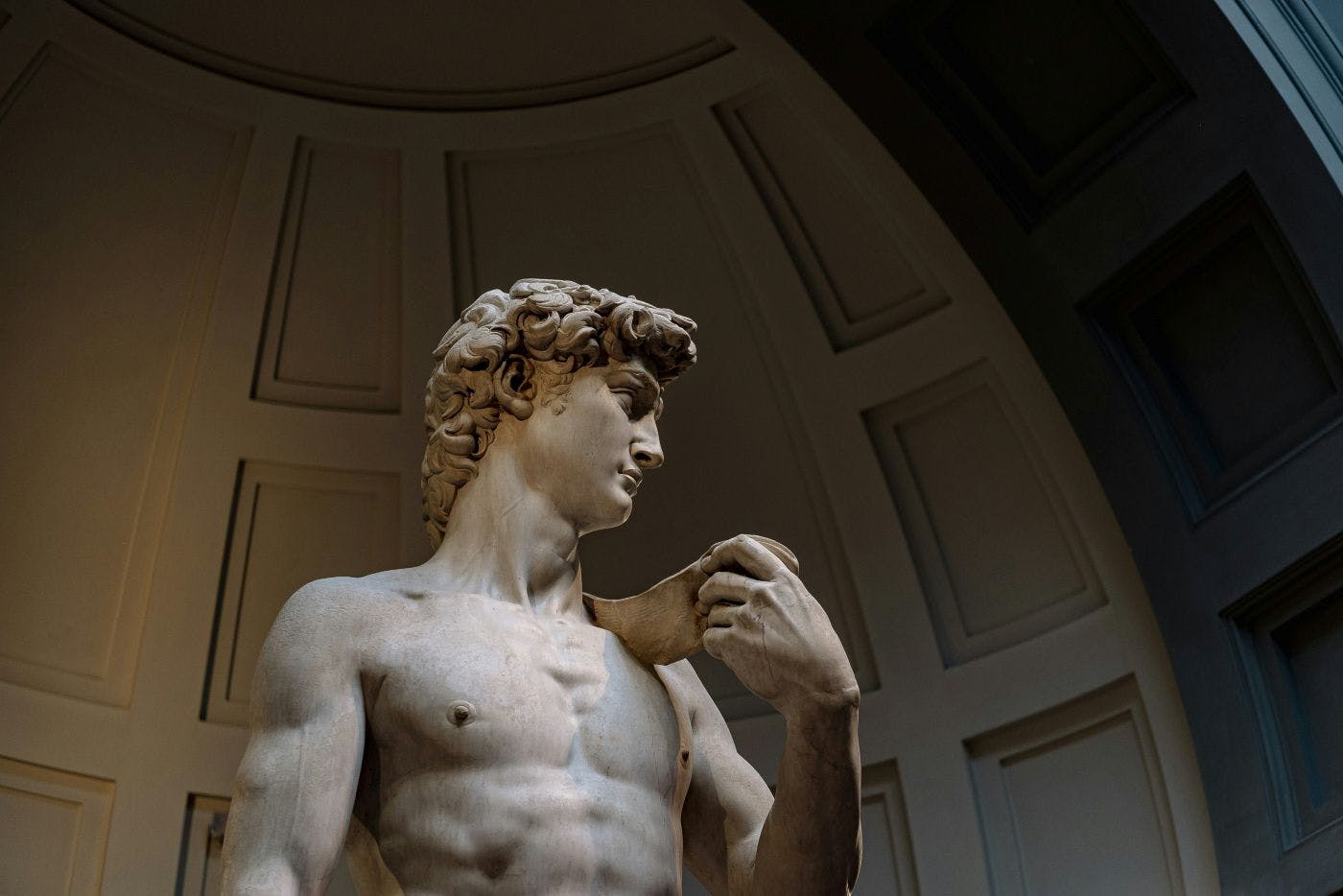
There it was, in the Galleria dell’Accademia in Florence. Just standing there. Not staged. Not announced. Waiting. I remember moving through the museum and then stopping short, almost without realizing why. You see pictures of it. People talk about it. I’ve even used it as a punchline to a bad joke now and then. But nothing prepares you for seeing it in person. Awe is the only word that fits.
I felt the same thing when I saw the Pieta at the Vatican. Awe. Simple, pure awe. The way marble becomes flesh under the artist’s hands is hard to explain without sounding exaggerated. But that’s exactly what it feels like. The stone feels alive. With The David, you feel the tension in the body, the moment just before action. It feels like it could burst from the marble and send the stone flying across miles to strike Goliath again and again.
With the Pieta, Mary holds the body of her son across her lap, and you feel the weight of grief in the figures. Loss. Love. The beginning of a life that will now be defined by absence. Again, the marble becomes flesh and feeling. And again, the experience is overwhelming in the best way.
When I met movie stars, I felt excitement. I felt delight. I never felt awe. Awe comes from something otherworldly. Actors, no matter how talented, are people with good PR. These statues are objects made by someone who seemed connected to something far larger than themselves. Whether you call it God, the cosmos, or something else entirely, you feel it. And that feeling is what creates awe.
Awe makes us feel small and humble. And at the same time, deeply human. It isn’t planned. You can’t prepare for it. At the Vatican, the guide said something like, prepare yourself, some people find the Pieta overwhelming. And she was right. It was overwhelming. Not in a way that shuts you down, but in a way that opens something up.
Psychologists write about awe as something that’s good for us. It helps us mentally and emotionally. It humbles us. It inspires us. It slows us down. It forces us to stop doing and simply be, even if only for a moment.
I noticed something else when I saw both pieces. There was a pause before the phones came out. A second or two where no one moved. Part of it was people trying to figure out the rules. Are we allowed to take pictures of this? It almost felt absurd to even ask. Surely this is proof of something sacred. Turns out you can take pictures. Just no flash. The same is true at the Vatican.
But I don’t think the pause was only about rules. I think we were all momentarily stunned. Unsure how to behave. Unsure what the correct response was. We didn’t know what to do with ourselves yet.
After seeing both statues, I felt different. Smaller, but hopeful. Humbled, but energized. I walked the rest of the day in a state of awe. Not constantly, but quietly. It lingered. It was glorious.
Today, sitting at my desk, I came across photos of both statues in an ad for travel in Italy. I felt nothing. I remembered the feeling, but I didn’t feel it. The photos were dull, poorly lit, and taken from angles that flattened everything remarkable about the work. They didn’t move me at all.
I didn’t take any pictures of either statue when I was there. What would have been the point? A travel guide or a history book can give me the same image. A photo doesn’t recreate presence. It doesn’t capture scale. It doesn’t transmit tension, weight, or silence. Even the best professional photography falls short. Awe doesn’t survive translation very well.
So today, I found myself revisiting those moments in my head. My boss asked if I was writing. I said yes. And now here I am, writing about awe. And wondering something out loud.
I’m wondering if there are brands that leave us in awe. And if so, why? And whether it’s even possible for something we interact with every day to create that feeling.
If awe is possible with a brand, it isn’t because the brand tried to create it.
Most brands aim for admiration. Admiration is safe. You can design for it. Measure it. Repeat it. Admiration fits neatly into presentations, campaigns, and awards. You can plan it. You can optimize for it.
Awe doesn’t work that way.
Awe happens when something stops trying to impress you and simply exists with enough confidence and intention that you have to adjust yourself in its presence. You don’t lean in. You step back. You get quiet. You feel small. And then, somehow, more human.
That’s what those statues did. They weren’t asking anything of me. They weren’t explaining themselves. They weren’t trying to be accessible, friendly, or optimized. They just were.
This is where most brands lose the thread.
They overexplain. They polish. They soften edges. They shrink ambition so no one feels uncomfortable. They add messaging, features, and campaigns until the original idea is buried under effort. What remains is something respectable. Something admirable. Something easy to photograph.
But not something that stops you cold.
Awe requires scale, but not bigness. It requires restraint, not minimalism. It requires intent, not cleverness. The mass matters. The silence matters. The sense that nothing is winking at you matters.
You can’t screenshot awe. You can’t campaign it into existence. You can’t feel it in a feed, a thumbnail, or a deck. Just like those photos of The David did nothing for me at my desk, most brand expressions fail because they are representations of something rather than the thing itself.
Presence is the difference.
The brands that come closest to awe don’t feel like performances. They feel like places. Sometimes literal. Sometimes not. You don’t rush through them. You don’t fully understand them immediately. You spend time with them. And for a moment, you forget yourself.
That pause in the museum before the phones came out, that’s the tell. That’s where awe lives. The moment when documentation feels wrong. When witnessing feels like enough.
Most brands never create that moment. And maybe that’s fine. Awe isn’t efficient. It isn’t scalable in the way business likes to talk about scale.
But when it happens, it stays with you. Quietly. And it makes me wonder whether that’s something worth aiming for. Not as a tactic. Not as a strategy. But as a reminder that the things that move us most are rarely the things that try the hardest to be liked.
The Pause
That pause before the phones came out stayed with me. It was brief, almost imperceptible, but it felt shared. A few seconds where no one reached for anything and no one spoke. People just stood there, suspended, as if waiting for permission that wasn’t coming from a sign, a guard, or a rule.
Some of that was practical uncertainty. Are photos allowed? Is this respectful? Is there a line we’re about to cross without meaning to? But that wasn’t all of it. There was something else in that hesitation, something harder to name. Documenting the moment felt premature. Or maybe inappropriate. As if turning it into an image would interrupt something that hadn’t fully landed yet.
We’re trained now to respond instantly. Something appears, and the reflex is automatic. Capture it. Frame it. Prove you were there. Experience collapses into evidence almost immediately. We’ve shortened the distance between seeing and sharing to the point where it barely exists.
Standing in front of those statues, that reflex faltered. No one raised a phone right away. There was a collective pause, like the room itself had taken a breath. For a moment, being present felt like the only available response.
That isn’t a state we occupy very often anymore. We live inside representations. Screens, images, highlights, previews. Even memory feels provisional without a photo to confirm it. We don’t quite trust what we felt unless we can replay it.
Awe doesn’t fit easily into that system. It asks for stillness before action. It asks you to register where you are in relation to what’s in front of you. It takes time to arrive, and during that time, reaching for a device feels like skipping ahead before you know what you’re skipping past.
Eventually, the phones came out. Screens lifted. People shifted positions to get better angles. The choreography of modern tourism resumed. But the pause had already done something. The awe had already passed through the room.
I think about how rare that kind of interruption is now. How few things slow us down enough to disrupt our instincts. How uncomfortable it feels not to know what to do next. And how quickly we try to resolve that discomfort by turning experience into content.
Awe doesn’t erase that urge. It delays it. And in that delay, something recalibrates. You stop narrating yourself for a moment. You’re not framing, performing, or anticipating the share. You’re simply there.
That state doesn’t last. It never does. But when it appears, it’s unmistakable. Most things never create it. They’re consumed instantly, understood instantly, and forgotten just as quickly. They don’t ask anything of us beyond attention.
Awe asks for orientation first. And that difference matters more than we tend to notice.
Admiration became the goal
Watching people move through the world, it’s hard not to notice how quickly admiration shows up and how little it asks of us. We nod. We approve. We register something as good, well done, or impressive enough. Then we move on. It’s a clean transaction. Nothing sticks to us on the way out.
You see this everywhere. In stores designed to be instantly legible. In products that explain themselves before you’ve had a chance to feel them. In brands that are very careful to make sure you’re comfortable at all times. Clear signage. Friendly language. Smooth edges. No pauses long enough to feel awkward.
Admiration fits neatly into that environment. It rewards clarity, effort, and it rewards things that behave as we expect. You don’t have to change your posture, your pace, or your assumptions. You just recognize the work, maybe appreciate it, and keep moving.
Awe asks for something different, and you can feel people recoil from that without realizing they’re doing it. Awe slows things down. It creates moments where the script doesn’t quite apply yet. Where you’re not sure if you’re supposed to engage, respond, document, or just stand there. That uncertainty is uncomfortable. Most systems are built to eliminate it as quickly as possible.
So we train ourselves out of it.
We gravitate toward things that tell us what to think and how to feel right away. We favor experiences that translate cleanly across screens and summaries. We trust what looks good in motion and photographs well in pieces. There’s a kind of relief in that. You know where you stand. You know what’s expected of you.
Even the brands that want to feel bold often pull back at the last second. They soften the idea. They add context. They make sure no one feels lost. What might have been a moment becomes a message instead. What might have been a presence becomes a performance.
None of this is especially cynical. It’s practical. It’s learned behavior. When you watch how people respond, you can see the feedback loop at work. Things that go down easily get rewarded. Things that require patience or adjustment tend to get passed over, or misunderstood, or quietly revised until they behave better.
Admiration survives that process. Awe rarely does.
Awe doesn’t compress well. It doesn’t always explain itself. It can feel excessive, or indulgent, or strangely silent where we expect noise. It resists being turned into proof. And that makes it hard to defend in rooms where everything needs to justify its existence.
Most of the time, we don’t even notice it. We fill the space with things that work just fine. Things that earn approval. Things that look good when reduced.
But every once in a while, something breaks through. Something refuses to hurry. Something doesn’t quite care if you’re ready for it or not. And when that happens, you can feel people hesitate. You can feel the room adjust. You can feel the difference immediately.
It’s subtle, but it’s real. And once you’ve noticed it, it’s hard not to see how rare it’s become.
Being there
At some point, the copy replaces the thing.
You can feel it when you’re handed an experience that already knows how it wants to be understood. Before you’ve touched it, before you’ve spent time with it, it’s already telling you what it is. What it stands for. How to talk about it. What to feel. The language arrives first. The presence comes later, if it comes at all.
Most of the time, that’s invisible. We’re used to it. We move through representations all day. Screenshots of places we haven’t been. Stories about products we haven’t held. Campaigns standing in for realities we’ll never actually encounter. It’s efficient. It saves time. It lets us participate without committing.
But there’s a difference between knowing about something and being with it, and the difference shows up in the body before it shows up in thought.
When something is present, truly present, it has weight. Not just physical weight, but psychological weight. It asks you to orient yourself around it. You notice where you’re standing. You notice how long you’ve been there. You notice that you can’t quite take it in all at once.
Representation doesn’t do that. Representation flattens. It crops. It selects the most legible angle and discards the rest. It gives you something you can hold quickly and move past. It’s not trying to deceive you. It’s just doing what it’s designed to do.
The problem is what happens when representation becomes the primary experience rather than a doorway to it.
You see this when a thing feels familiar before it feels real. When you recognize the language, the tone, the posture, before you’ve had any direct contact, it creates a strange sense of déjà vu. Like you’ve already been somewhere you haven’t actually visited yet.
That familiarity kills a certain kind of attention. There’s no need to linger. No reason to pause. You already know what this is. Or at least you think you do.
Presence resists that. It doesn’t arrive pre-translated. It doesn’t explain itself right away. It lets you misunderstand it for a while. It lets you feel slightly out of step. That friction isn’t a flaw. It’s part of how depth announces itself.
This is why screenshots feel so thin compared to the thing itself. Not because they’re poorly made, but because they can’t carry scale, or silence, or time. They show you what something looks like without showing you what it’s like to stand in front of it.
And the more we rely on representations, the more we begin to design for them. Things get shaped to survive reduction. Edges are softened so they don’t get lost when they’re cropped. Meaning is pushed to the surface so it doesn’t disappear when it’s summarized. What can’t be captured cleanly gets trimmed away.
What’s left works well enough. It travels. It performs. It behaves.
But it doesn’t ask much of us.
Presence asks more. It doesn’t rush to make sense. It doesn’t care if it photographs well. It exists on its own terms, and you either meet it there or you don’t. That’s a harder relationship to maintain, especially when everything around us is built to move faster.
Still, every now and then, you encounter something that hasn’t been fully translated yet. Something that feels heavier than its explanation. Something that doesn’t quite fit inside the story being told about it.
And when that happens, you can feel yourself slow down. Not because you’re trying to, but because you have to. There’s no shortcut. No preview that will do. You’re either there, or you’re not.
That’s the difference. And once you’ve felt it, it’s hard not to notice how much of what surrounds us never even tries.

What it asks of you
Some things ask more of you than you expect, and not in obvious ways. Not louder. Not more complicated. Just slower. Heavier. Less eager to meet you where you already are.
You can feel people negotiating with that demand in real time. They shift their weight. They glance around. They look for cues. How long am I supposed to stay here? What am I meant to do with this? Is there a right response I’m missing?
We’re used to experiences that reassure us immediately. That tell us we’re doing it right—that reward quick understanding. When something doesn’t do that, when it withholds clarity for a moment, it can feel almost impolite, like it’s failing to do its job.
But sometimes the job is exactly that. To not rush you.
Presence tends to come with a kind of restraint that’s easy to misread. It doesn’t pile on information. It doesn’t stack explanations. It doesn’t try to earn your approval sentence by sentence. It leaves space, and that space can feel unsettling if you’re not sure how to occupy it.
Scale plays into this, but not the way we usually mean it. It’s not about size for its own sake. It’s about proportion. About encountering something that doesn’t immediately resize itself to fit your expectations. Something that keeps its own dimensions, even if that makes you feel slightly out of place.
There’s also intent, which shows up less as messaging and more as coherence. You sense when something knows what it is and isn’t trying to be anything else. That certainty doesn’t announce itself. It doesn’t need to. It just holds.
Polish can actually get in the way here. When everything is smoothed and optimized and explained, there’s nothing left to press against. No resistance. No grain. You slide right over the surface and move on, unchanged.
The things that linger tend to have edges that aren’t fully sanded down. Not flaws exactly, but signs that they weren’t built to accommodate every angle of approach. They assume a little patience. They assume you’ll meet them halfway.
That assumption is rare now. Most experiences are designed to remove friction entirely, to make sure nothing slows you down or asks too much. And most of the time, that’s what we want. Convenience is a powerful sedative.
But every so often, you feel the cost of it. Everything starts to blur together. One thing replaces another without leaving much behind. You’ve seen a lot, but you haven’t really been anywhere.
When something finally resists that pattern, even gently, it can feel almost physical. You notice your breathing. You notice the passing of time. You notice yourself paying attention in a way that isn’t transactional.
Nothing dramatic happens. There’s no reveal. No takeaway neatly packaged at the end. Just a sense that you were required to show up a little more fully than usual.
That requirement is easy to avoid. It’s much easier to admire from a distance, to appreciate without adjusting your posture or your pace. But when you do stay with it, when you let something keep its scale and its silence, the effect is hard to shake.
You don’t leave with a summary. You leave changed in small, quiet ways. And you only realize it later, when something else feels thinner by comparison.
Why it won’t behave
There’s a reason experiences like this don’t fit cleanly inside systems.
Systems like predictability. They like inputs and outputs that behave themselves. They like knowing what comes next. Awe has a way of breaking that agreement. It doesn’t arrive on schedule. It doesn’t repeat itself reliably. It doesn’t always land the same way twice, even for the same person.
You can watch people try to systematize around that discomfort. They look for rules. They look for proxies. They look for ways to guarantee the feeling without risking the uncertainty that precedes it. Over time, the work shifts. Less time is spent on the thing itself; more time is spent explaining it, packaging it, and defending it.
This is how environments get crowded. Not physically, but cognitively. More language. More cues. More reassurance. The original impulse is still there somewhere, but it’s wrapped in so much support that it barely has room to breathe.
What’s strange is that this wrapping is usually done out of care. Care for the audience. Care for clarity. Care for avoiding misunderstanding. No one sets out to drain the life out of something. It happens incrementally, through well-intentioned decisions that all make sense on their own.
But awe doesn’t benefit from being protected that way. It benefits from being left alone.
When something is allowed to stand without constant explanation, it develops a kind of gravity. People have to orient themselves to it rather than the other way around. That shift can feel risky. It can feel like relinquishing control. But it’s also where depth comes from.
This is why awe can’t be forced. The moment it feels engineered, it collapses into performance. You feel the hand behind the curtain. You sense the effort. And effort, once visible, changes the relationship. You’re no longer encountering something. You’re evaluating it.
Evaluation is the opposite of awe.
Evaluation keeps you upright, separate, in charge. Awe tilts the floor slightly. Not enough to knock you over, just enough to remind you that you’re not the center of the room.
Most experiences today are designed to keep you firmly in control. To make sure nothing surprises you too much. To make sure you’re never unsure how to respond. That’s comforting. It’s also flattening.
Every once in a while, something slips through that doesn’t obey those rules. Something that doesn’t care if it’s efficient or defensible. Something that doesn’t rush to justify its existence. And when it does, you can feel the difference immediately.
People slow down. Conversations quiet. There’s less commentary and more looking. Less positioning and more presence. The system pauses, just briefly, because it doesn’t know how to process what’s happening yet.
Those moments don’t scale well. They aren’t tidy. They don’t reproduce on demand. But they linger. They work on you after the fact, when you’re no longer inside them.
And that might be their value. Not that they can be replicated endlessly, but that they remind us what it feels like when something doesn’t need our approval to matter.
The Takeaway
I keep coming back to the desk.
The day goes on. Emails arrive. Tabs multiply. Whatever I was doing before I drifted off into memory pulls me back in. The feeling fades the way feelings always do. Not abruptly. Just gradually, until it’s no longer in the room with me.
But it leaves a trace.
I don’t feel awed sitting here. I’m not meant to. The desk doesn’t ask anything of me beyond attention and productivity. It behaves. It does its job. Still, something from those moments in Florence and Rome stays just close enough to notice. A sense of contrast, maybe. Or absence.
This is the kind of thing we talk about at ThoughtLab, often without using this language. Why some work lands cleanly but disappears. Why some ideas perform well but never really stay with you? Why clarity and polish, on their own, rarely change how people feel once they leave the room.
Images don’t quite land the same way anymore. Language feels busier than it needs to be. Effort shows itself too quickly. I notice how fast everything wants to explain itself, justify itself, win me over. How little patience there is for silence, or scale, or uncertainty.
I don’t think this is about nostalgia, or museums, or even art. It feels more like remembering a state you didn’t know you’d slipped out of. A way of being with something that didn’t require commentary or proof.
That pause comes back to me again. The moment before the phones came out. Before anyone decided what to do next. It didn’t last long, but it felt intact. Untouched. Like a small pocket of time that hadn’t been optimized yet.
I don’t know if it makes sense to want that from the things we build and interact with every day. Maybe it’s unrealistic. Maybe it’s unnecessary. Most things work just fine without it.
But I do know what it felt like to stand there, briefly uncentered, unsure how to respond, and quietly changed by the encounter. And I know how rare that feeling has become.
So when we talk at ThoughtLab about work that matters, work that lasts, work that moves people beyond admiration, this is what I’m thinking about. Not spectacle. Not cleverness. Just the possibility that something might ask us to slow down, adjust our posture, and be present for a moment longer than we expected.
Not everything should do that. Probably most things shouldn’t.
But every once in a while, it feels worth remembering what it’s like when something does.
