
Great brands, like great performances, come from knowing yourself well enough to choose. Letting AI polish every choice quietly gives that freedom away.
I read John Steinbeck’s East of Eden while I was doing a production of Of Mice and Men. I suppose I was going through a Steinbeck period, which is a wonderful thing to experience if you’re interested in the human condition and don’t particularly mind being emotionally beaten with a shovel. His characters suffer, struggle, and make terrible decisions, usually in situations where a nice cup of tea and a reassuring hug won’t solve much of anything. Hence my love of his work.
Some time later, I met the woman who would become my best friend, and one of our earliest conversations, over coffee, was about East of Eden. We discovered that we both loved the section in which a character named Lee discusses a single Hebrew word: timshel. I realize that two people discussing biblical translations over coffee doesn’t sound like the beginning of a beautiful friendship. It sounds like the beginning of a very disappointing first date, possibly involving pamphlets. But there we were, happily discussing Steinbeck, theology, and the extraordinary power of one little word.
In the novel, Lee becomes fascinated by the different translations of a passage from Genesis in which God speaks to Cain about sin. The King James Bible translates it as a promise: “Thou shalt rule over him.” (The “him,” in this case, is sin.) The American Standard Version makes it a command: “Do thou rule over him.” One translation says humanity will overcome sin; the other says humanity must. Either way, God seems to have a fairly definite opinion about the matter.
But Lee isn’t satisfied. He and a group of elderly Chinese scholars spend years studying Hebrew, trying to understand what the passage actually means. Imagine that for a moment. Years spent wrestling with a single word. I can barely spend fifteen minutes trying to remember why I walked into the kitchen.
Eventually, they arrive at an interpretation that changes everything. Timshel. “Thou mayest.” Not a promise. Not a command. A choice.
Now, before someone with a doctorate in biblical Hebrew comes charging through my front door waving a concordance and demanding satisfaction, I should point out that Steinbeck’s interpretation isn’t universally accepted. Even the spelling is a little off: most scholars would transliterate the word as timshol. So the most famous word in the book is, strictly speaking, a little wrong. It doesn’t seem to have done the book any harm. What fascinates me isn’t whether Steinbeck settled a theological argument. It’s what he did with the possibility that those two words might be true.
Thou mayest.
You may choose to do good. You may choose to do evil. You may rise above your history, your family, your circumstances, and the spectacular collection of bad decisions you’ve accumulated over the years. Or you may not. Nothing is guaranteed, and nothing is demanded. The choice, and the responsibility that comes with it, belongs to you.
I love that, and I think I finally know why. A real choice is one you can get wrong. That’s what makes it yours. If the outcome were guaranteed, there would be nothing to choose; if perfection were required, there would be no room to try. Steinbeck’s God isn’t demanding perfection or promising it. He’s handing over the freedom to stumble, fail, make a mess of things, and learn something along the way. Imperfection isn’t the price of that freedom. It’s the evidence of it.
What a relief. I’ve been imperfect for most of my life, sometimes professionally, and it’s nice to discover I may have been operating within acceptable theological parameters all along.
But here’s where my mind wanders into considerably less sacred territory.
Today, those scholars could have typed their question into an AI program and received an answer in seconds. No years of study, no spirited arguments over ancient texts. Just a question, a blinking cursor, and an answer delivered with the kind of confidence usually reserved for people who have no idea what they’re talking about.
That answer might have been wrong. Or incomplete. Or perfectly accurate and utterly meaningless to the person receiving it. That’s what interests me.
Those scholars weren’t simply looking for the correct translation. They were searching for meaning. The process mattered. The disagreement mattered. The possibility that they might be wrong mattered. Years of wrestling didn’t just produce an answer; they produced people capable of recognizing it when it arrived. Hand them the answer on the first day, and they might have nodded politely and moved on.
I’m not suggesting God has an opinion about ChatGPT, although I imagine He’d have a few concerns about its biblical scholarship. Nor am I suggesting that using AI to improve a sentence is a theological offense. If it were, a considerable number of marketing departments would already be facing eternal damnation, and most of them have enough trouble meeting their quarterly objectives.
But I do wonder whether our growing habit of asking machines to improve everything we make is slowly convincing us that imperfection is something to eliminate rather than something to understand. And if we keep asking them to make our words better, our ideas clearer, and our choices safer, at what point do we stop making the choices at all?
Thou mayest. But will we?

The Trouble With Perfect
I’ve spent a good part of my life as an actor, which means I’ve spent much of my life pretending to be people far more interesting than I am. Some have been charming, some despicable, and a few so profoundly unpleasant that I was relieved to leave them at the theater when the evening was over.
One thing acting has taught me is that perfection isn’t particularly interesting. Some of the most memorable moments I’ve experienced onstage happened when something went wrong.
A line gets dropped. Someone enters too early. A door refuses to open, which is particularly unfortunate when the scene requires a dramatic exit. Suddenly the carefully rehearsed machinery of the performance breaks down, and you’re standing there with another actor, both of you trying to figure out what the hell happens next.
And sometimes, something wonderful happens.
You stop thinking about the performance. You stop anticipating the next line, the next movement, the next carefully planned emotional revelation. You simply react, not as yourself, but as the character you’ve spent weeks trying to understand. For a few extraordinary seconds, you’re no longer executing a performance. You’re living inside it. Those are the moments I live for.
I’ve always been fascinated by the expression “out of character.” We use it when someone surprises us. The quiet fellow in accounting loses his temper in a meeting. A perfectly respectable executive says something so spectacularly inappropriate at a company dinner that everyone at the table suddenly develops an intense interest in the mashed potatoes. “Well,” we say, “that was out of character.” But was it? Or did we just see something that person normally keeps hidden?
I think about that a great deal when I’m working on a role. Every character has constructed a version of themselves to present to the world: manners, habits, rehearsed responses, and a firmly locked door for everything else. Sound familiar? What interests me isn’t the construction. It’s what happens when it collapses: when fear gets the better of them, when love makes them ridiculous, when something happens they simply weren’t prepared to handle. That’s where I look for the truth of a character. Not in the perfectly delivered speech, but in the moment the character loses control of the person they’ve been pretending to be.
There’s an irony in all this. We spend weeks rehearsing so that we can eventually experience a moment that feels entirely unrehearsed. We memorize every word so we can say it as though for the first time. We practice our movements so that they appear spontaneous. We spend hours constructing a character so that, if we’re very lucky, we can forget the construction altogether.
And none of it happens without the preparation. The freedom to respond truthfully when the door sticks comes from knowing the character well enough to trust yourself. It’s what Lee’s scholars were doing with their Hebrew: rehearsing for years, so they’d recognize the truth when it finally showed up.
Which is why I’m wary of the shortcut. You could ask an AI for the ideal line reading of any speech in Steinbeck, and it would give you something perfectly competent. But a line reading isn’t the work. The work is the weeks of getting it wrong that teach you who the character is, so that when the evening goes off script, you know what they’d do. Skip that, and you can deliver every line flawlessly and still have nothing to say when the door won’t open.
That’s what I find so interesting about imperfection. It isn’t necessarily a failure of the work. Sometimes it’s the moment when all the work finally reveals something worth seeing.

The Brand Behind the Curtain
I’ve often wondered how many companies spend their entire existence playing a character they don’t understand. They’ve got the costume, the lines, and the carefully rehearsed performance: a lovely logo, a handsome website, and a mission statement that promises to change the world. Everyone knows their lines. Nobody has the slightest idea who they’re supposed to be. And heaven forbid someone should go off script.
That’s the trouble with building a brand from the outside in. You start with what you want people to see rather than what’s actually there. You create an image, polish it until you can see your reflection in it, and then spend years trying to convince everyone, yourself included, that the image is the truth. It’s like putting on a tuxedo to take out the garbage. You look impressive, but you’re still carrying the garbage.
These days there’s an even faster way to do it. Ask a machine for a mission statement, a set of brand values, and a tagline, and it will hand you exactly what a company like yours is supposed to sound like, because it has read every company like yours. That’s the problem. An identity assembled from the average of everyone else is a costume borrowed from the competition. It’s the corporate version of letting the machine choose your sentence, except this time the sentence is who you are.
Before I can play a character truthfully, I have to understand the person beneath the performance: what they’re afraid of, what they want, why they behave the way they do, which choices they’ve made and which ones they’re terrified of making. Otherwise I’m just a dude in a costume reciting lines, and anyone who’s sat through a dreadful community theater production knows how painful that can be.
Branding is no different. If you don’t understand the company beneath the image, all you’re doing is decorating the facade. You may make something attractive, even impressive, but attractiveness isn’t identity. A beautiful logo can’t compensate for a company that doesn’t know what it stands for, any more than an expensive pair of shoes can turn a terrible actor into Laurence Olivier. (I’ve worked with a few people who seemed determined to test that theory.)
That’s why, at ThoughtLab, depth comes before design. We do the difficult, sometimes uncomfortable work of understanding a company before we decide how it should present itself: what makes it tick, what it believes, where it came from, and what it might become. We look for what distinguishes it from everyone else in its industry, including the things it may have spent years hiding because somebody in a conference room decided they weren’t sufficiently professional. Those are usually the rough edges a committee, or a machine, would sand off first.
That’s also where a category of one begins. Plenty of companies look different; some look different because somebody made an unfortunate decision involving a gradient and an aggressive shade of orange. Being different isn’t hard. Being meaningfully different is another matter. A category-of-one brand knows what makes it unmistakably itself. It doesn’t borrow its personality from the competition or disguise its peculiarities to keep everyone comfortable. It knows what it believes and whom it serves, and it has the confidence to make choices that reflect those convictions. Sometimes those choices challenge an entire industry’s accepted wisdom. Sometimes they make the people around the conference table shift in their chairs, which isn’t necessarily a bad sign.
Because once you’ve done the work of understanding who you are, you have something enormously valuable: the freedom to choose.
And there’s Steinbeck again, wandering into the marketing department with his little Hebrew word, looking around at the mood boards and brand guidelines, and probably wondering what happened to literature.
Timshel. Thou mayest. You may build a brand that looks and sounds like everyone else’s. You may follow the research, or the algorithm, so obediently that it quietly escorts every interesting possibility from the room. You may sand away every rough edge until nothing is left that might offend, surprise, or inspire anyone. Or you may choose to become something nobody else can be. Yourself.
That’s the work we believe in at ThoughtLab. Not manufacturing a personality, but discovering one. A brand polished into perfect conformity may never make a mistake. It may never make much of an impression, either.
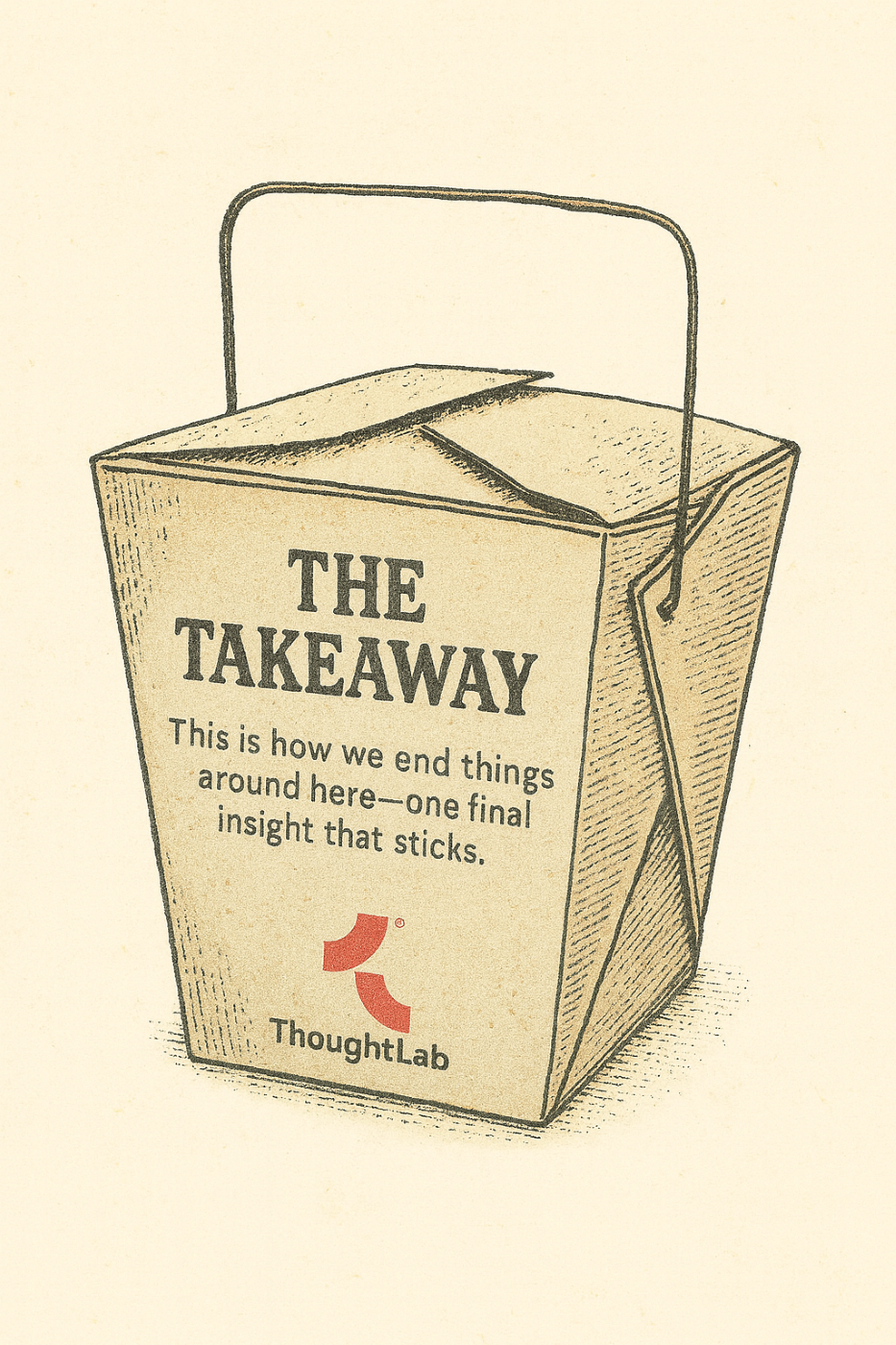
The Takeaway: Thou Mayest
I don’t believe artificial intelligence is the enemy of creativity, any more than I believe the spellchecker is responsible for the decline of Western civilization. AI is a tool, and a remarkable one. It can help us write better sentences, explore unfamiliar ideas, and answer in minutes questions that might otherwise take days. I’ve spent enough time staring at a blank screen, wondering whether the English language has finally run out of words, to appreciate a little help.
But there’s a difference between using a tool to help you make a choice and letting the tool make the choice for you. In our enthusiasm for getting everything right, we’re becoming uncomfortable with the possibility of getting anything wrong. We want the perfect sentence, the perfect image, the perfect brand, polished and optimized in case someone, somewhere, raises an eyebrow. And every time we accept the safest version, we hand over a little more of the choosing.
The best brands, like the best performances, come from the opposite instinct: understanding yourself deeply enough to trust your own choices, even the unexpected ones. That’s why depth comes before design, and why a category of one takes more than an attractive identity and a clever tagline.
I think about those nights onstage when the carefully rehearsed performance suddenly became something none of us anticipated. Those are the moments I remember. Not because we made a mistake, but because the mistake opened a door, and for a few wonderful seconds something truthful came through. Something nobody could have planned, rehearsed, or perfected.
And I think about Lee and those elderly Chinese scholars, spending years wrestling with a single word. They could have accepted the translation they were given and gone about their lives. Instead, they chose to keep looking, and in Steinbeck’s telling, their search uncovered an idea that changed the meaning of everything that followed.
Timshel. Thou mayest.
You may use every tool available to make your work better. You may question the answers you’re given, challenge the rules you’ve inherited, and take the occasional spectacularly ill-advised creative risk. You may be wrong. You may be brilliant. On particularly ambitious days, you may manage both before lunch. But the choice is still yours. And wouldn’t it be a shame to give it away just because a machine can write a perfectly respectible sentence?